The three of us have created this blog to share our research on Classroom Talk. Read more about us as individuals below! To visit a website about Classroom talk, click here.
I am Janessa Davis, and as a pre-service teacher, I am currently in my second semester of practicum. As a former Biology major, I have grown in my knowledge base and love for the sciences, and decided to make this my concentration to supplement my current Inclusive Childhood Education major. I am actually in a 6th grade science classroom for my practicum experience, and I love it! One of my favorite aspects of this type of discipline is the need to ask questions. I have been able to learn so much about asking questions as a form of scaffolding to help students with their own discovery of concepts. As a future teaching professional, my goals are to incorporate mindfulness, make learning fun, and foster agency in students. In relation to classroom talk, I believe that the way in which we talk to one another as well as how we talk about certain things has a huge impact on what we think and how we think. To incorporate mindfulness, certain characteristics of classroom talk (such as contingency) are necessary. I also believe that the way we speak impacts how exciting a topic can be. If the teacher isn’t too excited about the material… why would students be? Lastly, communication and classroom talk have so much influence on student agency. Being a self starter and being able to communicate in general is so important in life within school and beyond.
Hi! I am Katie Zirilli. Ever since I can remember, I have wanted to be a teacher. Teaching has been my long-term goal since I was in second grade. I have been greatly impacted by my teachers throughout the years, and they have inspired me to want to become a teacher who influences young lives. I am currently pursuing my dream as I major in Inclusive Childhood Education and Math. Getting hands-on experience in the classroom this semester is showing me who I am as an emerging educator. As a future teacher, I want to find fun, interactive ways for students to engage with me and each other so they do not have to sit still for so long. I have learned how important classroom talk is as my fifth graders’ attention span is about ten minutes long and they stay engaged for longer when their are opportunities for them to talk to their peers. My goal for my future classroom is to find lots of ways to teach my students while incorporating lots of opportunities to do more than just listen to me lecture. I want to encourage my students to ask questions and model good questions each day as I ask students to engage critically with the material.
What’s up my fellow readers, I am Jordan Holmes the best blogger in Houghton. I just recently found out that I want to pursue teaching as my career. I always liked the social aspect of school, but never really liked sitting through class and learning outside of math and science classes because of the creative thinking it made me do. I really never even thought I would ever get into the teaching profession until I thought about what I would not only be good at, but enjoy. Then it clicked when I was coaching a basketball camp for little kids and I realized I had a knack for connecting with children and I have fun doing it. I am an ICE major with a math/science concentration which I believe is going to suit me perfectly. I am currently in a second grade classroom for my practicum internship and I love every second of it, even when I am secretly begging for a nap. This experience has given me a real look at what it takes to be an educator of the young. As a future educator, my goals are to create a culture of unity within my classroom, to make learning fun for my students and to become someone whom my students can look up to (literally and metaphorically). I will promote listening to one another and trying new things within my classroom. These goals will fuel me to become the best teacher I can be and hopefully allow my students to be the best learners and people they can be. I believe my experiences from basketball have helped to fund my knowledge towards teaching.
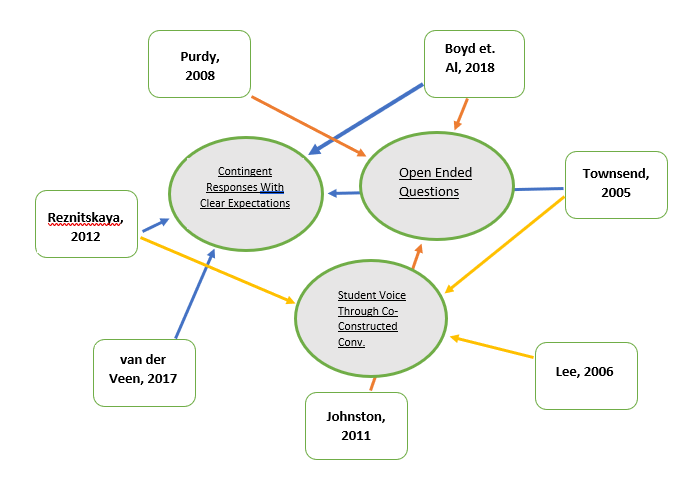
During this journey, we focused our research on one question: “How can we use classroom talk to foster an inviting classroom culture?”. We started by gathering articles that talked about both classroom talk and classroom culture. We wanted to make sure that each article we chose was relevant to our research question. The next step was reading and annotating each article so that we could learn more about the effect of classroom talk on classroom culture. Although we started out knowing a lot of information, this journey has taught us so much more. Our research has led us to three key ideas that help us answer our research question. We have learned about the importance of fostering contingent responses by providing students with clear expectations for talk. We have learned how essential open-ended questions are in order to begin and continue conversations. We have also learned how valuable it is to make sure students have a voice by providing students equal opportunity to co-construct conversations.
See below for a graphic that we made to depict the three key ideas that these articles all connected with.
Through our journey, we found a recurring theme in our articles. Many of the articles we found stressed the importance of fostering contingent responses among our students by providing them with clear expectations. They found that “the classroom context which is good for inquiry is one that values interaction” between students (Townsend, 2005, p. 604) and that this interaction fosters an inviting classroom culture. When students have the ability to build off one another’s responses, contingency, they feel more open to sharing their ideas and perspectives. In this case, “the teacher does not prompt students to support their positions with reasons, to consider alternatives, or to question assumptions or implications” (Reznitskaya, 2012, p.451). Instead the teacher expects the students to control the conversation which leads to critical thinking and connection making. Not only does this lead to more engaged learning, it also leads to students building trust with one another. As students learn how to share their ideas with their peers and build off their peers responses, they learn how to communicate respectfully. This respect is a key component in creating an inviting classroom culture. Productive classroom talk …
“encourage[s] young students to (a) share, expand, or clarify their initial ideas or thoughts; (b) listen to one another and take one another’s ideas seriously; (c) deepen their reasoning; (d) think together and build on one another’s ideas; and (e) reflect on their communicative performance” (van der Veen, 2017, p. 690).
When students are expected to learn how to do these five things, they are being set up for success, not only in school but also in life. Students need to learn how to express their thoughts and ideas and think metacognitively. Giving them opportunities each day to do these things will make them better communicators throughout their life and help promote a classroom community where everyone feels like they matter. Additionally, these articles believe that students “deserve the planned and contingent, responsive and responsible, messy, dialogic and localized forces of effective teaching and learning talk” (Boyd et al., 2018, p.2). This kind of dialogue is relevant and empowering. It makes sure each student has a chance to share and have a voice in the classroom. Classroom talk empowers student voice and fosters respect among the members which in turn helps to create an inviting classroom environment for all.
The theme of open-ended questions connects well with our overarching question of “How can we use classroom talk to foster an inviting classroom culture?”. Open-ended questions allow respondents to include more information, including feelings, attitudes and understanding of the subject. This allows teachers to better access the true feelings of the student. This was seen in the Johnston article,
“However, these questions are more significant than that. They require the students to imagine themselves into the heads of the characters, to analyze the characters’ feelings and motives, to construct another’s mind and imagine the workings of that mind in a context. Developing students’ social imaginations like this affects their social relationships, their self-regulation, and their moral development” (Johnston et al., 2011, p.233).
You have to remember that it is important to nurture students’ interests when trying to create an inviting classroom culture. So if you do when you are creating open ended questions then you will create more meaningful dialogue among your students. In the Boyd article it said
“Students come to know if a teacher is asking questions that he/she is actually interested in hearing an answer to, or if the teacher is asking questions that seek a predetermined response. This influences whether students explore ideas or risk sharing opinions” (Boyd et al., 2018 p.4).
We need to help our students think about the questions they have and how we can answer these questions with more than a simple one worded answer. When reading a text you naturally develop questions, assisting the student with guiding questions will help the student get on the path to developing their own response to their questions. In the Purdy article it stated “Good readers question as they read (Pressley, 2002) and it is through questions that teachers can support the thought processes that accompany reading” (Purdy, 2008, p.46). Overall, open-ended questions connect very well in creating an inviting classroom culture because it stirs up classroom talk and gets a perspective on a situation.
Lastly, we found that many of these articles aligned with the idea that it is important to make sure students have a voice. One of the articles states “one important aspect of Cultural Modeling has to do with how participation through talk is organized” (Lee., 2006, p.308). Through looking into the meaning behind the organization of talk, the culture of the classroom can be especially affected. This was also shown by providing students equal opportunity to co-construct conversations, specifically through dialogic teaching. What is dialogic teaching? One of the articles that we looked at focused on this especially, and defined it in many ways. One example would be “dialogic teaching reflects social-constructivist theories of learning” (Reznitskaya, 2012, p.448). This shows that through working together as a class, dialogic teaching involves the group constructing thought together through talking contingently. Reznitskaya, 2012, states, “in dialogic classrooms, teachers and students act as coinquirers, collaboratively engaging in a generation and evaluation of new interpretations of texts in order to “gain a fuller appreciation of the world, [them]selves, and one another” (Burbules, 1993, p. 8)” (Reznitskya, 2012, p.446) Another piece of evidence from this article is
“Participants in a dialogic discussion collectively formulate, defend, and scrutinize each other’s viewpoints, negotiating and constructing new meanings. As a result, they observe, try out, and eventually appropriate general intellectual dispositions and specific linguistic skills, which they can use whenever they need to resolve complex issues” (Reznitskya, 2012, p.448).
There are many obvious benefits for this kind of classroom talk framework. Not only are students heard and able to practice listening to their peers as they develop the discussion, but there is a sense of freedom in that the students as a collective whole are able to pose new questions and thoughts to the dialogue that has the ability to enrich the classroom culture. This was demonstrated in an example from one article, stated as, “In this class, students had become members of a narrative audience and encultured as active participants into a pattern of talk in which they themselves could initiate topics that would draw the attention of their teacher and their classmates” (Townsend, 2005, p. 599).
As you can see, there are many ideas and strategies that have been discovered about how classroom talk works. In search of answers to our main question, “How can we use classroom talk to foster an inviting classroom culture?”, we found three common themes — contingent responses, open-ended questions, and student voice expressed through co-constructed conversations — were revealed throughout the multiple articles that we found.
A Few Notes From The Authors
Hi, this is Katie! This journey has provided me with so much insight on how I can use classroom talk to create an inviting classroom culture. I have learned a lot about how to support and encourage students’ use of contingent talk in the classroom. Additionally, I have learned how useful open-ended questions are when beginning and continuing the conversations that are built on contingent talk. I saw these ideas put into practice for a short bit during practicum before the schools were all closed. During this time, I saw how important questions can be to help students think critically about the material and how they can encourage students to engage with their peers. When students do not understand a concept, it is extremely important that they feel comfortable engaging in dialogue with their peers in order to better understand what they are confused about. Engaging in contingent talk and creating an atmosphere filled with trust and respect lead to an environment that is inviting to students. This inviting environment is what I want to create in every classroom that I am a member of as I believe students learn better when they are in an environment where they feel safe and welcome. In order to learn more about how to foster respect in my classrooms, I will read the article below and see what they suggest. https://www.teacher.org/daily/creating-environment-respect-rapport/
What up what up, It’s Jordan here. As an individual I have taken a lot away from doing research on classroom talk. A key idea that impacted me the most is the idea of listening to understand (asking a question) and not listening to respond. This is important especially when listening to your students because when you start to understand your student you will begin to figure out ways to help them succeed in the classroom and you will be able to create bonds with your students which will make them feel more welcomed inside the classroom. I had started to use this idea in my second grade classroom when talking with my students. For example, one of my students (Tara) told me she loves Scooby-Doo, instead of just telling her I like Scooby-Doo too I went with the approach of listening to understand and asked her the question of why she likes Scooby-Doo. She responded with “because Scooby is a dog and I have a dog and I love dogs”, This allowed me to actually understand her love of the Scooby-Doo series and we created a stronger bond because of it. I will continue this Idea in my future interactions with anyone to be honest because it shows the person you are talking to that you are interested in what they have to say and then they will feel more comfortable to open up.
Hello! It’s Janessa here, and I would like to share about what impacted me most during this process of looking to answer the question, “How can we use classroom talk to foster an inviting classroom culture?” Coming to this research topic of classroom talk, I thought I already knew a decent amount of information about what kinds of things we would find. I pictured talking, using certain inviting words or strategies for us as teachers. However, one of the biggest things that I have taken away from this research is that the answer seemed to not be what we as teachers will necessarily need to do, but what students can do. If we guide them in constructing the right kind of environment for talk, then they will be more open and able to guide the discussion in multiple and valuable ways. So far, I have decidedly asked more questions than giving statements to students in the classroom because I found that they are then able to open more to the topic that is being discussed. With the goal of getting students to speak contingently through modeling what that looks like when leading discussions as a teacher. To continue learning more about all the ways one can continue encouraging student interactions with each other in regards to classroom topics, I plan to use: https://teachingcommons.stanford.edu/resources/teaching/small-groups-and-discussions/how-get-students-talk-class
WHAZZZZUUUUPPPPP my fellow readers! It’s Jordan again and today I would like to talk more about the Cultural Model in classrooms. To discuss Cultural Modeling Framework I will discuss what I learned from an article I read written by Carol D. Lee titled: ‘Every good‐bye ain’t gone’: Analyzing the cultural underpinnings of classroom talk
Carol D. Lee, is an Associate Professor of Education and Social Policy in the Learning Sciences Program, as well as, of African-American Studies at Northwestern University. She was also previously the president of the National Conference on Research in Language and Literacy and is currently the Vice President of Division G of the American Educational Research Association.
In her article published in the International Journal of Qualitative Studies in Education her research explains the Cultural Modeling Framework for designing learning environments that achieve deeper conceptual understanding of everyday knowledge using culturally diverse students to support subject-matter specific learning. “It reports a study of Cultural Modeling in the teaching of response to literature in an urban underachieving high school serving African-American students from low-income communities who are also speakers of African-American English”. The study can provide new understandings of how cultural models and practices created in everyday life are taken up through constructive processes inside classrooms. This study is specific for efforts to create learning environments that meet the needs of ethnic and racial minority youth.
The data was collected from a three-year intervention in an urban high school. The school in this research was selected based on the student population being almost entirely African-American along with the fact that the school was on academic probation due to a history of low academic performance. The intervention involved the use of the Cultural Modeling in Literature curriculum and Carol D. Lee, also, taught one class each of the three years. Overall during the intervention there were quarterly assessments of students’ comprehension of short stories they had not read before, talk-aloud protocols of specific case study students, interviews with both students and faculty, field notes taken of faculty meetings and general activity in the school for each of the three years, as well as extensive video of classroom teaching by all of the English department faculty, including video of my own teaching everyday used to analyze and collect data for research.
The findings include that in Cultural Modeling classrooms students were most deeply engaged in literary debates during the following times (written specifically from the articles findings)
call and response
tonal semantics, including repetition and alliteration; narrative sequencing
rhythmic, dramatic, evocative language; use of proverbs, aphorisms, Biblical verses
sermonic tone reminiscent of traditional Black Church rhetoric, especially in vocabulary
imagery, metaphor; cultural references, ethnolinguistic idioms
verbal inventiveness, unique nomenclature
cultural values–community consciousness
and field dependency *working better in teams through interpersonal relationships*
Discussions of the research findings provide evidence that the students in this intervention were able to “transfer competences they developed from reasoning about everyday texts to reasoning about canonical literature: from examinations of the quality of reasoning about canonical texts that followed the modeling phase of instruction, from group assessments as well as from talk-aloud protocols of case study students, in both cases reading short stories they had not been taught” (Lee, 2006). Looking into the case described Lee explains that there may be a broader pattern of practical discussions within the mechanisms of teachings rooted in African-American English and their cultural discourse. Research also shows that it is most productive for learners to make connections between previous knowledge and new targeted learning that being said the article indicates that future research should aim to understand the range of diverse pathways of learning and development that are generative
However, some limitations may include that the study was done in a classroom of almost all African-American students with similar backgrounds and not in a diverse classroom, future research could also include research of AAE within more diverse classrooms
This provides useful information for our research on classroom culture because the Cultural Modeling Framework brings attention to scaffolding students’ everyday knowledge to support discipline-specific learning in schools. This is a unique concept and helps create an open mind in learning about the students cultural funds of knowledge and how to make use of that in classrooms.
References:
Carol D. Lee (2006) ‘Every good‐bye ain’t gone’: analyzing the cultural underpinnings of classroom talk, International Journal of Qualitative Studies in Education, 19:3, 305-327, DOI: 10.1080/09518390600696729
Alina Reznitskaya is the author of this article. She has a doctorate from the University of Illinois at Urbana-Champaign in Educational Psychology. She also graduated from Yale University, having done her post-doctoral research there.
The theoretical framework for the research in this article is centered around dialogic teaching. More specifically, there is the “Dialogic Inquiry Tool”. This is a scale of observations that is used in elementary ELA classrooms. The DIT uses these observations to analyze student/teacher relations in dialogic communication.
This study’s purpose was to inform readers that “known information findings” are detrimental to learning when in a class discussion. This is referred to as“recitation”, and can limit the quality of learning that takes place in the classroom. Recitation lowers the levels of cognitive engagement and function, as well as student interest, while dialogic teaching in classroom communication emphasizes the importance of language in the construction of higher level thinking. Despite the multitude of research that exists, proving that dialogic teaching is much more beneficial than monologic teaching, it is still not very present in today’s schools.
The methodology behind DIT begins with observations of short recordings of classroom discussion that usually last around 20 minutes. They can also observe through real time discussion as well. Then, teachers are asked to state what the purpose was of their lesson. What was their goal? This helps teachers to later reflect after observing the classroom dialogue. There are several indicators that the DIT will be analyzing the dialogue for. The teacher will take notes on each of these indicators as they are observing the classroom talk. Indicators include the quality of the following areas: authority, feedback, questions, meta-level connection (connecting student ideas), explanation, and collaboration.
In a dialogic classroom, it is observed that power and authority of the content and how it is discussed is a shared portion of the discussion. It is also found that the divergent questions that arise from this type of dialogue opens the possibilities for learning and intrigues its participants. There is also more feedback for the teacher to work with, and therefore, instruction and discussion are responsively adaptable.
Since it is our goal to learn more about how to create a more inviting learning environment through classroom culture and talk, this research seems to be useful in causing the classroom to grow more as a community where its members share and co-construct the conversations around the topics that are discussed. By co-constructing talk in the classroom through dialogic teaching and communication, all members of the class therefore have a valuable voice in the class, as well as a part in the discussion as a co-contributor that brings their own unique perspective and life experiences.
A limitation of the DIT is one expressed by the author of this featured article. The author states that dialogic classroom discussion is imperative, but should not become the monopolizing way of classroom communication. It was added that the reason for bringing the importance of this tool to light is because many students rarely experience this type of learning in their school careers.
Many different research tools and processes that can be helpful in the classroom can be too much for a classroom teacher to use and teach simultaneously. A useful feature of using DIT in the classroom is much more efficient and doable for classroom teachers. The author states that it is a specialized scale that aids in the understanding and the examination of classroom talk and its quality in literature discussion.
Hi! This is Katie again! Today I am going to talk to you about what I learned from the article “The many faces of gertrude: Opening and closing possibilities in classroom talk – teachers’ and students’ understandings of classroom culture affect students’ development of critical thinking abilities. two classrooms with contrasting cultures are described here”.
Jane S Townsend and Barbara G Pace, professors at the University of Florida researched the connection between classroom talk and the classroom community. They pulled from two separate research studies conducted by two different researchers about Gertrude, Hamlet’s mother. One study was done on a writing-about- literature class in a community college taught by Mr. Phillips who has 20 years of experience.The purpose of this study was to find out how members of an interpretive community experienced the class, including their perceptions and understanding. The other study was done on an 11th grade literature class of 15 students taught by Ms. Hale who has 6 years of experience. The purpose of this study was to describe the students’ discourse moves, perspectives, and wonderings in a classroom context.
They found that as students adjust to the workings of the classroom community, they respond to the conversations in a way that is appropriate to their setting. If the classroom community allows open dialogue, then students will be exposed to multiple perspectives and will be given the opportunity to open their minds and think critically. If the classroom community is more closed, then students will not be given the opportunity to share their ideas. They also found out more about the benefit of questions in classroom dialogue. Asking questions in a way that allows for different answers and perspectives encourages students to actually answer the question because they will not be so afraid of being wrong. Students in Mr. Phillips class were always asked closed questions — questions that Mr. Phillips was looking for a very particular answer to. Because of this, the students would not really answer his questions because they never knew what he was looking for and thus they no longer wanted to try to guess. In contrast, the students in Ms. Hale’s classroom felt the freedom to not only answer their teacher’s questions, but to also ask questions of their own and pose their own musings to the class.
Additionally they recorded that the different degrees of contact the members of the classroom community have with one another play a factor in how comfortable members were in sharing their thoughts with the others during class. It is important to remember to create a space where students feel like they are fully members of the community so that they feel comfortable initiating dialogue that interests the other members of the classroom. When this space is created students feel comfortable dialoguing not only with their teacher, but also with their peers.
One limitation of this paper is that it only discusses two studies done about two classrooms. There are so many classrooms in the world that it can be hard to make generalizations when we are only given data about two of these classrooms. Additionally, these two classrooms were composed of very few students, approximately 15 students. Thus, we have no data on how classes with more students would have responded. But we did learn that the physical environment is especially important to consider when creating a classroom culture that is inviting to all students. It is important to configure the physical environment in such a way that invites students to dialogue with one another — it is suggested that students sit in such a way that they can see each others’ faces. Creating relationships with one another enables the students to feel comfortable with each other and allows them to participate in dialogue.
Here is the citation for this article:
Townsend, J., & Pace, B. (2005). The many faces of gertrude: Opening and closing possibilities in classroom talk – teachers’ and students’ understandings of classroom culture affect students’ development of critical thinking abilities. two classrooms with contrasting cultures are described here. Journal of Adolescent & Adult Literacy : A Journal from the International Reading Association,48(7), 584. https://search.proquest.com/docview/216916955?accountid=11488
What’s up my fellow readers! It is THE GREATEST BLOGGER in the North East…. Jordan, Classroom Talk, Holmes coming at you with another Blog.
Classroom talk is important and the language we use with children influences many assets in the child’s life.
The article I chose to annotate today is Talking in class: Remembering what is important about classroom talk.
Peter H. Johnston grew up and taught elementary school in New Zealand before coming to the United States to earn his Ph.D. His research explores the relationships among classroom talk, engagement, and children’s social, emotional and literate development. How our language affects children’s learning. He believes that education is not simply about delivering information to children. He thinks it is as much about building a just, caring society as growing intellectually as well as socially.
This article discusses how Amy, a middle school teacher, uses classroom talk on a daily basis to get insight on her students thinking. Sam is an eighth-grade student in Amy’s class, he gives a book talk on In Ecstasy (McCaffrey, 2009). This book is told across the shifting perspectives of two best friends struggling with drugs and relationships. After Sam tells about the life of one of the two characters spiraling downward, Amy asks, “If you were her best friend, what would you tell her?”
Asking your students guiding questions is a great way to stir up classroom talk and get a perspective on a situation. Classroom talk involves a lot of different aspects but student comprehension is really what’s important here. you can check for understanding by asking preliminary questions connecting the topic to students’ prior experiences and knowledge which may seem trivial, but in actuality are important threads in classroom talk. Amy makes it clear that encountering problems while reading is normal and certainly not an indicator of inability, Which is a comment proven to boost students level of confidence and relieve much stress when coming across texts.
Some of Amy’s questions require the students to discuss decision-making processes they themselves might face. This is another positive as the student is basically practicing talking through real life scenarios that they may or may not come across in their social palette. Language choice as a teacher is very important to the students development. There is a big difference between When a teacher says, “How did you do that?” instead of “Good boy!” The first comment allows the student to think about his or hers thinking well the second one actually produces the reverse. In other words, affective connections to reading can be triggered by what we say and closed-ended questions and comments can easily reduce the chance of engagement. There can be limitations to this method because you need to be careful not to over look the content. The content of what the student needs to learn is still important and you can’t forget to continue to teach the student and not have them try to learn everything on their own.
“Teaching is not simply about developing individual minds. We have to help students learn to build productive learning communities as well.” This is an important concept as we need to help the student learn ways to build on their own learning whether than just have them except a right or wrong answer. This whole article is reviewing one of my favorite topics which goes by the name of COGNITIVE THINKING AKA thinking about your thinking.
Hi! This is Katie and I want to share what I learned about creating a welcoming classroom community that supports students’ virtual schoolbag and fund of knowledge. To learn more about this, I read “Trusting the local: Opening up the script with response-able talk practices”.
Maureen P. Boyd and Elizabeth Tyann, Associate Professors of education at the University at Buffalo, and Lori Potteiger, a doctoral student of education at the University at Buffalo, conducted a study of an urban elementary classroom to learn about the effectiveness of going off script and instead teaching based on the local. They hoped to learn more about how to cultivate a welcoming classroom culture by fostering response-able talk and using dialogic instruction in the classroom. They wished to show how important it is for teachers to not teach just from a script, but to instead value and connect to the local–not just local resources and connections but also the in-the-moment contributions that the students have to offer on a daily basis.
Tyann, and Potteiger looked at a second grade classroom in an urban elementary school. The class has 25 students, one teaching assistant, and one teacher. They focus on one day they observed, Thursday, so that they could focus on Morning Meeting and other activities that value the local. They looked at the class handshake that the students help to build throughout the year, the morning sharing time where students can share about something that relates to what they are learning or that is important to them, and the writing activities that showcase topics the students care about. They found that teachers who practice dialogic instruction and foster response-able talk in their classroom help to cultivate a welcoming classroom community. This practice not only enables students to learn the content that they need but it also gives them the opportunity to make critical connections that reinforces what they are learning.
One limitation of this study is that this paper is based on a one day study of one classroom in an urban elementary school and pulls from other studies. More research must be done in order to provide more thorough evidence that using the local instead of a script is more effective in creating a welcoming classroom culture. But, they did see the importance of nurturing the classroom community and cultivating the local, making sure the students have a voice and the teacher is tappinging into their funds of knowledge. They are not calling for teachers to throw out the script completely, but to instead use it as a guide instead of a script. Teachers need to have the ability to go off script and tailor their instruction to their students and all of their diverse needs.
Boyd, M. P., Tynan, E. A., & Potteiger, L. (2018). Trusting the local: Opening up the script with response-able talk practices. English Teaching, 17(1), 2-15. doi:http://dx.doi.org/10.1108/ETPC-09-2017-0125
This is Janessa here with you to discuss an article that gives insight to conversations in the classroom for English Language Learners (ELLs)!
The article and study, “Inviting conversation: meaningful talk about texts for English language learners”, was written by Joyce Purdy. Purdy is an Educational Consultant at the University of Alberta. She also has a PhD in Literacy and English.
The purpose of this study is to examine conversations between ELL students and teachers during guided reading. Understandably, there is a growing diversity in school populations. This study hopes to gain some insight into how to best meet the needs of culturally diverse students.
This study was conducted in an urban setting with a high ELL population. The age of the students involved in the study are in third grade classrooms. The author who conducted this study is familiar with the teacher and the school. Within this particular third grade classroom, there were three English Language Learners, all of whom consented to this study. Specifically, there were two students of the three that the study concerned the most. One student, referred to as Todd, spoke Vietnamese. The other student spoke Cantonese and is referred to as Kenton in the study. From general observation, the two students, Todd and Kenton, interacted freely within the class and participated well in the activities that took place. The observer tape-recorded dialogue in the classroom to analyze how verbal communication was used.
Through the observation of this guided reading dialogue including ELLs, Todd and Kenton, this researcher found connections between elements of questioning, explaining, and collaborative talk. The suggested ways to improve our talk in literacy and verbally guided activities, like guided readings, that were found are “questioning, teaching vocabulary, inviting collaborative talk and adopting a culturally sensitive point of view.” Talking about text and specific text features can be very helpful, and even more so for ELLs. The first suggestion was to use questions. This is talked about as important because questions are asked by good readers and by teachers in order to enhance the process of meaning making. Specifically, open-ended questions are discussed as being more inviting for rich dialogue, even though questions with only one right answer is what is asked most commonly. The next suggestion, teaching vocabulary, is proven to be an imperative portion of reading development for ELLs. Even if ELLs are capable of holding fluent conversation with peers and teachers, what many teachers do not know is that there is still a significant gap in word knowledge. In order to support ELL students in this area, it is suggested practice to explain new vocab in an explicit way, rather than attempting to access student funds of knowledge. Another suggestion for this category, is to limit the number of words that are new to seven or less for each lesson, as not to overwhelm ELL students. Next, it is mentioned that it is important to invite collaborative talk. This is to emphasize both social and personal aspects of learning into the mix. Lastly, we have the adoption of a culturally sensitive view. The author of this article articulates that to have a caring learning environment where everyone feels invited and welcome starts from an inclusion of home culture in school programs.
In the introduction of this article, the common scenario of a guided reading experience is given. This scenario depicts a small guided reading group that is sharing their experiences with bowling. This connection to real-life is acknowledged by all students as familiar, yet the ELL students in the group do not share any kind of fundamental experiences that could relate to the story when the time for sharing comes as a part of Vygotsky’s theory of socially-constructed thought.
The limitations of this study involve the study of only two students and their interactions with teachers and peers in a guided reading group. This is not only just in a single third grade classroom, but also limited further to a couple of the ELL students that are present in the classroom. This extremely small pool of data in which conversations were recorded is not necessarily a representation of every third grade classroom and ELL within them.
Purdy shares some ways in which teachers can best support ELLs and other culturally diverse students. This is important for creating a welcoming classroom culture, as students are being supported and considered when structuring dialogue around classroom talk in ways that benefit such students. To be able to participate and contribute is a large component of building one’s identity in the group (class) as a whole.
While we’ve been away, we have refined our research question. We will now be focusing on the question:
How can we use classroom talk to foster an inviting classroom culture?
For our first article annotation we choose “MODEL2TALK: An Intervention to Promote Productive Classroom Talk”.
Chiel van der Veen, Femke van der Wilt (doctoral candidates of education at Vrije Universiteit, Amsterdam), and their colleagues from the Netherlands and the United States conducted research about talk in the classroom that is supportive of students’ learning and thinking. The intervention used is referred to as the MODEL2TALK intervention. This is described as a form of dialogic instruction, which is intended to support productive classroom talk. After asking the teachers to lead the same discussions (about animals) all groups were filmed in discussion for the first and last times these discussions were held. The average age group that represented the student portion of the study was around five years old. There were 469 students and 21 teachers involved in the study. The researchers analyzed the 21 teachers and their classrooms during class discussion using a “pretest-intervention-posttest” model of data collection. Students were then tested for conversational skills and communicative function.
They found that the MODEL2TALK intervention drastically improves students’ communication and promotes a culture that helps students to think and communicate together. These skills are essential in supporting students’ oral communication skills in different sociocultural contexts as well as developing an inviting classroom culture. The MODEL2TALK intervention is based on having Productive Classroom Talk, a form of dialogic talk, which helps students to find a voice for their thoughts, to build off their peers’ thoughts, to deepen their reasoning skills, and to reflect on how they communicate. This kind of talk supports students’ academic learning and thinking. They encourage teachers to start by picking a topic that the students’ like and will engage with. And during the conversation, the teacher uses talk moves to help draw out students’ thoughts and ideas. They also found that the intervention didn’t have any effect on subject matter knowledge, but was significantly related to their level of social acceptance.
There are some limitations found during this intervention. The data collected is from 21 different teachers and their students. Since this implies that only 21 classrooms were involved in the study, not every classroom situation possible can be simulated through this pool of data. Students were encouraged to share their ideas, reasoning, and thoughts together. As a consequence, they often came up with unexpected ideas and interesting questions that were beyond the scope of the teacher’s manual and our subject matter knowledge test. Some useful features from this intervention are that teachers found the productive talk moves to be helpful tools in supporting students’ shared thinking and communicating. In a relatively short intervention period, teachers are able to use these talk moves in their classroom discussions. This emphasizes how a classroom can and should have social acceptance because of how valuable it is to listen to different ideas and perspectives. Their ability to listen, and communicate ideas, impacts their social acceptance from others and their social acceptance of others.
van der Veen, C., van der Wilt, F., van Kruistum, C., van Oers, B., & Michaels, S. (2017). MODEL2TALK: An intervention to promote productive classroom talk. Reading Teacher, 70(6), 689–700. https://doi.org/10.1002/trtr.1573
From what we have already learned in our previous classes, we know classroom talk affects the culture, discourse, relationships, and other variables in the classroom.
The culture is affected by attitude, motivation, and knowledge which can be expressed and established through talk both explicitly and implicitly.
It expresses discourse which varies among different disciplines. It is influenced by home, school, and other institutions.
Classrooms function best when they run on understanding build through relationships, which require communication. Talk is one form of communication.
It’s an essential tool that can be used in activities and structures that are required to attain concepts (used when explaining or exploring).
Can be influenced by more than just the teacher (students, tv, culture).
It’s not always about the semantic features of what you say, but also how you say it. So much more than just the words you say, also has to do with facial features, the tone you use, etc..
What do we want to know?
Who are the experts on classroom talk philosophies, methods, or strategies?
What kinds of behavior management strategies benefit classroom talk?
When is an appropriate time for students to talk?
Why does the way we talk in the classroom pertain to classroom management?
How can we facilitate good classroom talk?
In other words, what are different classroom management strategies, methods, and philosophies that (pertain to classroom talk) help teachers to monitor, inspire, or motivate student talk?
Articles
Davies, M., Kiemer, K., & Meissel, K. (2017). Quality talk and dialogic teaching—an examination of a professional development programme on secondary teachers’ facilitation of student talk. British Educational Research Journal,43(5), 968-987. doi:10.1002/berj.3293 https://onlinelibrary.wiley.com/doi/abs/10.1002/berj.3293
van der Veen, C., van der Wilt, F., van Kruistum, C., van Oers, B., & Michaels, S. (2017). MODEL2TALK: An Intervention to Promote Productive Classroom Talk. Reading Teacher, 70(6), 689–700. https://doi.org/10.1002/trtr.1573








 Let's Talk About Talk