During this journey, we focused our research on one question: “How can we use classroom talk to foster an inviting classroom culture?”. We started by gathering articles that talked about both classroom talk and classroom culture. We wanted to make sure that each article we chose was relevant to our research question. The next step was reading and annotating each article so that we could learn more about the effect of classroom talk on classroom culture. Although we started out knowing a lot of information, this journey has taught us so much more. Our research has led us to three key ideas that help us answer our research question. We have learned about the importance of fostering contingent responses by providing students with clear expectations for talk. We have learned how essential open-ended questions are in order to begin and continue conversations. We have also learned how valuable it is to make sure students have a voice by providing students equal opportunity to co-construct conversations.
See below for a graphic that we made to depict the three key ideas that these articles all connected with.
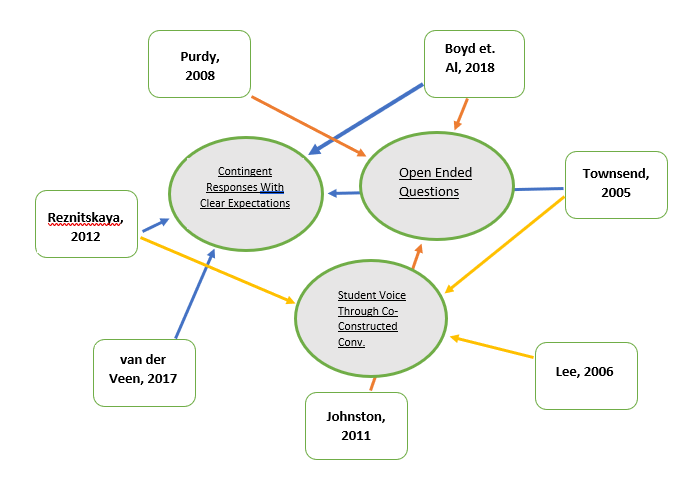
Through our journey, we found a recurring theme in our articles. Many of the articles we found stressed the importance of fostering contingent responses among our students by providing them with clear expectations. They found that “the classroom context which is good for inquiry is one that values interaction” between students (Townsend, 2005, p. 604) and that this interaction fosters an inviting classroom culture. When students have the ability to build off one another’s responses, contingency, they feel more open to sharing their ideas and perspectives. In this case, “the teacher does not prompt students to support their positions with reasons, to consider alternatives, or to question assumptions or implications” (Reznitskaya, 2012, p.451). Instead the teacher expects the students to control the conversation which leads to critical thinking and connection making. Not only does this lead to more engaged learning, it also leads to students building trust with one another. As students learn how to share their ideas with their peers and build off their peers responses, they learn how to communicate respectfully. This respect is a key component in creating an inviting classroom culture. Productive classroom talk …
“encourage[s] young students to (a) share, expand, or clarify their initial ideas or thoughts; (b) listen to one another and take one another’s ideas seriously; (c) deepen their reasoning; (d) think together and build on one another’s ideas; and (e) reflect on their communicative performance” (van der Veen, 2017, p. 690).
When students are expected to learn how to do these five things, they are being set up for success, not only in school but also in life. Students need to learn how to express their thoughts and ideas and think metacognitively. Giving them opportunities each day to do these things will make them better communicators throughout their life and help promote a classroom community where everyone feels like they matter. Additionally, these articles believe that students “deserve the planned and contingent, responsive and responsible, messy, dialogic and localized forces of effective teaching and learning talk” (Boyd et al., 2018, p.2). This kind of dialogue is relevant and empowering. It makes sure each student has a chance to share and have a voice in the classroom. Classroom talk empowers student voice and fosters respect among the members which in turn helps to create an inviting classroom environment for all.
The theme of open-ended questions connects well with our overarching question of “How can we use classroom talk to foster an inviting classroom culture?”. Open-ended questions allow respondents to include more information, including feelings, attitudes and understanding of the subject. This allows teachers to better access the true feelings of the student. This was seen in the Johnston article,
“However, these questions are more significant than that. They require the students to imagine themselves into the heads of the characters, to analyze the characters’ feelings and motives, to construct another’s mind and imagine the workings of that mind in a context. Developing students’ social imaginations like this affects their social relationships, their self-regulation, and their moral development” (Johnston et al., 2011, p.233).
You have to remember that it is important to nurture students’ interests when trying to create an inviting classroom culture. So if you do when you are creating open ended questions then you will create more meaningful dialogue among your students. In the Boyd article it said
“Students come to know if a teacher is asking questions that he/she is actually interested in hearing an answer to, or if the teacher is asking questions that seek a predetermined response. This influences whether students explore ideas or risk sharing opinions” (Boyd et al., 2018 p.4).
We need to help our students think about the questions they have and how we can answer these questions with more than a simple one worded answer. When reading a text you naturally develop questions, assisting the student with guiding questions will help the student get on the path to developing their own response to their questions. In the Purdy article it stated “Good readers question as they read (Pressley, 2002) and it is through questions that teachers can support the thought processes that accompany reading” (Purdy, 2008, p.46). Overall, open-ended questions connect very well in creating an inviting classroom culture because it stirs up classroom talk and gets a perspective on a situation.
Lastly, we found that many of these articles aligned with the idea that it is important to make sure students have a voice. One of the articles states “one important aspect of Cultural Modeling has to do with how participation through talk is organized” (Lee., 2006, p.308). Through looking into the meaning behind the organization of talk, the culture of the classroom can be especially affected. This was also shown by providing students equal opportunity to co-construct conversations, specifically through dialogic teaching. What is dialogic teaching? One of the articles that we looked at focused on this especially, and defined it in many ways. One example would be “dialogic teaching reflects social-constructivist theories of learning” (Reznitskaya, 2012, p.448). This shows that through working together as a class, dialogic teaching involves the group constructing thought together through talking contingently. Reznitskaya, 2012, states, “in dialogic classrooms, teachers and students act as coinquirers, collaboratively engaging in a generation and evaluation of new interpretations of texts in order to “gain a fuller appreciation of the world, [them]selves, and one another” (Burbules, 1993, p. 8)” (Reznitskya, 2012, p.446) Another piece of evidence from this article is
“Participants in a dialogic discussion collectively formulate, defend, and scrutinize each other’s viewpoints, negotiating and constructing new meanings. As a result, they observe, try out, and eventually appropriate general intellectual dispositions and specific linguistic skills, which they can use whenever they need to resolve complex issues” (Reznitskya, 2012, p.448).
There are many obvious benefits for this kind of classroom talk framework. Not only are students heard and able to practice listening to their peers as they develop the discussion, but there is a sense of freedom in that the students as a collective whole are able to pose new questions and thoughts to the dialogue that has the ability to enrich the classroom culture. This was demonstrated in an example from one article, stated as, “In this class, students had become members of a narrative audience and encultured as active participants into a pattern of talk in which they themselves could initiate topics that would draw the attention of their teacher and their classmates” (Townsend, 2005, p. 599).
As you can see, there are many ideas and strategies that have been discovered about how classroom talk works. In search of answers to our main question, “How can we use classroom talk to foster an inviting classroom culture?”, we found three common themes — contingent responses, open-ended questions, and student voice expressed through co-constructed conversations — were revealed throughout the multiple articles that we found.
A Few Notes From The Authors
Hi, this is Katie! This journey has provided me with so much insight on how I can use classroom talk to create an inviting classroom culture. I have learned a lot about how to support and encourage students’ use of contingent talk in the classroom. Additionally, I have learned how useful open-ended questions are when beginning and continuing the conversations that are built on contingent talk. I saw these ideas put into practice for a short bit during practicum before the schools were all closed. During this time, I saw how important questions can be to help students think critically about the material and how they can encourage students to engage with their peers. When students do not understand a concept, it is extremely important that they feel comfortable engaging in dialogue with their peers in order to better understand what they are confused about. Engaging in contingent talk and creating an atmosphere filled with trust and respect lead to an environment that is inviting to students. This inviting environment is what I want to create in every classroom that I am a member of as I believe students learn better when they are in an environment where they feel safe and welcome. In order to learn more about how to foster respect in my classrooms, I will read the article below and see what they suggest. https://www.teacher.org/daily/creating-environment-respect-rapport/
What up what up, It’s Jordan here. As an individual I have taken a lot away from doing research on classroom talk. A key idea that impacted me the most is the idea of listening to understand (asking a question) and not listening to respond. This is important especially when listening to your students because when you start to understand your student you will begin to figure out ways to help them succeed in the classroom and you will be able to create bonds with your students which will make them feel more welcomed inside the classroom. I had started to use this idea in my second grade classroom when talking with my students. For example, one of my students (Tara) told me she loves Scooby-Doo, instead of just telling her I like Scooby-Doo too I went with the approach of listening to understand and asked her the question of why she likes Scooby-Doo. She responded with “because Scooby is a dog and I have a dog and I love dogs”, This allowed me to actually understand her love of the Scooby-Doo series and we created a stronger bond because of it. I will continue this Idea in my future interactions with anyone to be honest because it shows the person you are talking to that you are interested in what they have to say and then they will feel more comfortable to open up.
Hello! It’s Janessa here, and I would like to share about what impacted me most during this process of looking to answer the question, “How can we use classroom talk to foster an inviting classroom culture?” Coming to this research topic of classroom talk, I thought I already knew a decent amount of information about what kinds of things we would find. I pictured talking, using certain inviting words or strategies for us as teachers. However, one of the biggest things that I have taken away from this research is that the answer seemed to not be what we as teachers will necessarily need to do, but what students can do. If we guide them in constructing the right kind of environment for talk, then they will be more open and able to guide the discussion in multiple and valuable ways. So far, I have decidedly asked more questions than giving statements to students in the classroom because I found that they are then able to open more to the topic that is being discussed. With the goal of getting students to speak contingently through modeling what that looks like when leading discussions as a teacher. To continue learning more about all the ways one can continue encouraging student interactions with each other in regards to classroom topics, I plan to use: https://teachingcommons.stanford.edu/resources/teaching/small-groups-and-discussions/how-get-students-talk-class

 Let's Talk About Talk
Hi Jordan,
I really liked your practical take away from your research. Listening to understand instead of to respond is something I feel like we should be using in every aspect of our lives, especially in today’s culture. It’s so cool that you were able to use what you learned in your classroom. I didn’t know kids still watched Scooby Doo. Haha. Keep up the good work, dude!
LikeLike
Katie,
This was so insightfully written and it is clear that your group spent a lot of time really answering the questions and learning as much as you could through this experience. Talk is so important in a classroom as we are trying to build that positive atmosphere which you really recognize and are aware of. Thanks for sharing all of your thoughts during this! I have no doubt that you will take the information you have learned and start using it in your classroom as soon as you can! You are going to have some lucky students both in your student teaching classroom and one day in your own classroom!
LikeLike
Jan,
Just by reading your take away paragraph, I am so excited to spend some time reading all of your posts in this blog. I have been worried about my capability to foster classroom talk but I have a feeling I can learn a lot from your blog site 🙂 I have witnessed watching you talk to students and even friends who need help with a certain science class (inside joke), and you do a great job asking questions to help understanding as opposed to making statements. This is definitely a strategy I hope to use everyday when I am a teacher, because I have witnessed how well it works. Thanks for your thoughtful and insightful research in this topic. Can’t wait to read and learn more from you 🙂
-Brooke
LikeLike